We can't find the internet
Attempting to reconnect

Gym Equipment Alternatives: How to Train Effectively With What You Have
Your gym membership got cancelled, the commute stopped making sense, or you simply looked at the price and decided you'd rather not. You're not alone — and you're not stuck. The problem is that most home workout content either hands you a vague list of exercises with no context, or speaks to you like a motivational poster. Neither is especially useful when you're standing in your living room wondering what to actually do.
This article does something different. It maps specific gym machines and movements to equipment-free or low-cost alternatives, explains the principles behind why they work, and shows you how to keep making progress over time — no gym required.
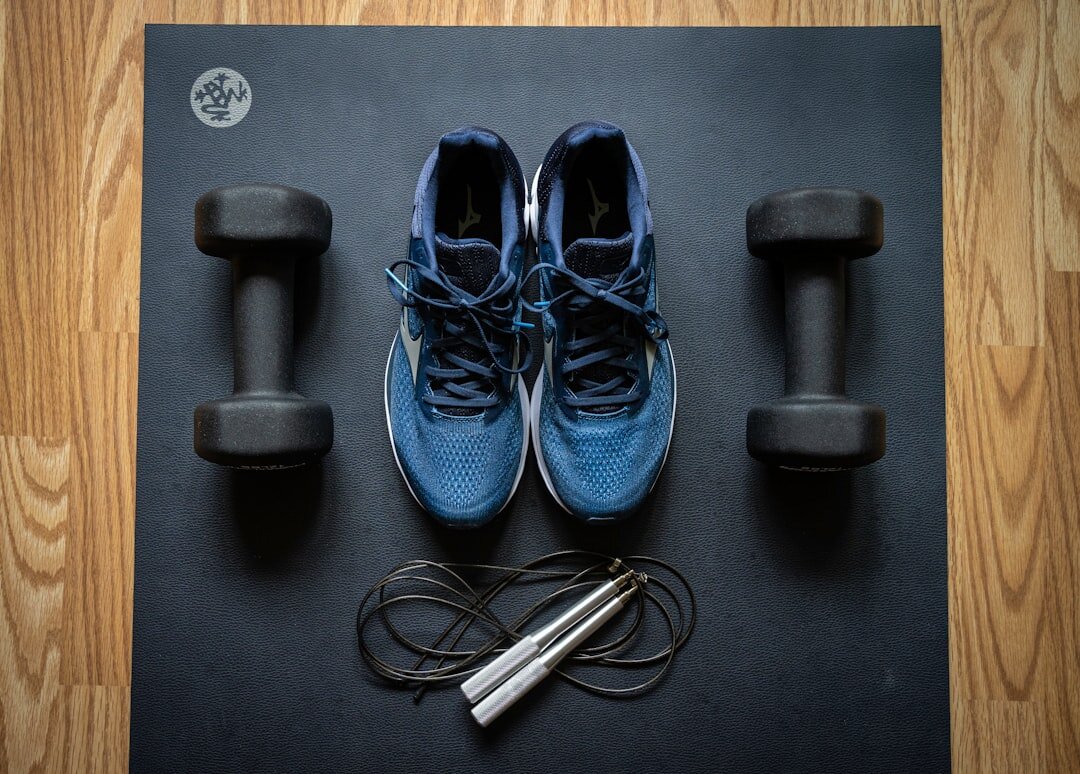 Photo by Alexandra Tran on Unsplash
Can You Actually Build Real Fitness Without Gym Equipment?
Yes — with one honest caveat. If your goal is to compete in powerlifting or chase an absolute strength ceiling, you'll eventually need a barbell. That applies to a small minority of people who train.
For everyone else — fat loss, a lean physique, improved fitness, feeling stronger and moving better — home training is not a compromise. It's a different method that produces comparable results.
Here's why: the gym is essentially a tool delivery mechanism. The tools matter less than what they create, which is mechanical tension in your muscles. Apply enough tension, progressively over time, and your body adapts. That process doesn't require a cable stack or a leg press. It requires understanding what stimulus you're after and knowing how to generate it with what you have.
The Four Movement Patterns You Actually Need to Train
Most training programmes — gym-based or otherwise — are built around four fundamental patterns. Train all four consistently and you're covering the body comprehensively. Skip one and you'll develop imbalances that become noticeable quickly.
Squat (Knee-Dominant)
In the gym, this pattern shows up as the leg press, hack squat, or barbell back squat. The goal is quad and glute development through a full range of knee flexion.
The most common mistake people make at home is treating bodyweight squats as a warm-up rather than working sets. That instinct isn't wrong — bodyweight squats are relatively easy for most adults. The fix is to change the variables rather than the movement.
Slow the tempo down: a 4-second descent with a 2-second pause at the bottom turns a forgettable squat into a genuinely demanding set. Alternatively, load the pattern — more on that in the progression section below. A rucksack filled with books will do more than you'd expect.
Hinge (Hip-Dominant)
The hinge — deadlifts, Romanian deadlifts, hamstring curls — is the most commonly skipped pattern in home training, usually because people assume they need something to pick up. They don't.
A towel hamstring curl on a smooth floor (wood or tiles work well) is a surprisingly effective substitute for a machine hamstring curl. Lie on your back with your knees bent, place your heels on a folded towel, and slowly slide your feet away from you until your legs are straight — then curl them back in, driving through your heels. It's harder than it sounds.
For a hinge pattern that mimics a Romanian deadlift, a loaded bag in a suitcase stance (bag to one side, hingeing from the hip) provides enough resistance to train the movement pattern properly and build genuine strength in the posterior chain.
Push (Horizontal and Vertical)
The chest press and shoulder press cover two distinct push directions — horizontal and vertical. Replicating both at home matters more than most people realise.
The fix for horizontal pressing is straightforward: press-ups, treated as strength work rather than cardio. The fix for vertical pressing — the most neglected at home — is the pike press-up. Get into a downward-dog position, lower your head towards the floor, and press back up. It's a shoulder-dominant movement that substitutes effectively for an overhead press. Elevating your feet on a chair increases the overhead emphasis further.
For upper chest development (which an incline press targets in the gym), try press-ups with your hands on the floor and feet elevated on a sofa or box.
Pull (Horizontal and Vertical)
This is the hardest pattern to replicate at home, and the one most frequently ignored entirely — usually to the detriment of posture and shoulder health. Lat pulldowns and seated rows develop the back, rear shoulders, and biceps. Without them, a push-heavy programme creates imbalances over time.
The most effective solution is a door-frame pull-up bar, which costs roughly £20–£30 and requires no drilling or permanent installation. It solves the pulling problem almost completely. If you can't yet do a full pull-up, resistance band assistance makes the movement immediately accessible. A set of resistance bands also gives you the option of horizontal pulling exercises like band face-pulls and pull-aparts, which replicate the cable machine's rear-delt work.
If you're new to these movement patterns, the Gymbile guide to building a beginner training plan from scratch covers how to put all four together into a full week of sessions.
Machine-by-Machine: The Direct Swap Guide
Here's what to do when you find yourself missing a specific piece of gym equipment.
Leg Press → Bulgarian Split Squat or Goblet Squat
Use a sofa or sturdy chair as rear-foot elevation for split squats. Load the movement with a rucksack filled with books. Slow the lowering phase to 3 seconds — this increases time under tension significantly and makes a bodyweight split squat a genuine challenge for most people.
Cable Machine → Resistance Bands
Resistance bands replicate the cable machine's key advantage: constant tension throughout the full range of motion. Bands can be stacked for more resistance, and a simple door anchor lets you adjust the effective cable height — high, mid, or low. For isolation work — curls, pull-aparts, lateral raises, rows — bands are particularly effective.
Lat Pulldown / Seated Row → Door Pull-Up Bar and Bands
A pull-up bar handles the vertical pull. For horizontal rows, anchor a band low (or wrap it around a table leg), sit back, and row towards your torso. Band-assisted pull-ups let beginners build the strength to progress to full, unassisted reps over several weeks.
Chest Press Machine → Press-Up Variations
Press-ups are strength work when you treat them that way. Slow the tempo, add pauses at the bottom, elevate your feet, or progress to more demanding variations like archer press-ups or single-arm press-ups (see the progression section). A Gymbile article on resistance band exercises includes upper-body pressing variations if you want to add band resistance to bodyweight pressing.
Treadmill / Rower → Stair Intervals or Skipping Rope
A skipping rope costs £8–£12 and provides serious cardio conditioning in roughly two square metres of floor space. Ten to fifteen minutes of rope work, interspersed with rest, is a highly effective cardiovascular session. Stair intervals — simply walking or running up and down a single flight of stairs for 15–20 minutes — require no equipment at all and are genuinely demanding.
How Resistance Bands Compare to Cables and Free Weights
Resistance bands provide what's called accommodating resistance: the tension is lower at the start of a movement (where you're weakest) and increases through the range as you approach the end position (where you're stronger). This is different from free weights, which provide constant resistance regardless of joint angle.
Different isn't worse. Research consistently supports training with bands as an effective stimulus for hypertrophy — provided sets are taken close to failure, the evidence suggests load is less important than effort level and training volume. A full set of resistance bands typically costs £10–£25 and covers light, medium, and heavy resistance.
The main limitation of bands is that it's harder to quantify your load precisely the way you can count kilograms on a barbell. The practical workaround is to track your reps and note whether the set felt easy, challenging, or at failure — that information is enough to programme progression.
Bands are particularly well-suited to isolation movements: rows, pull-aparts, bicep curls, lateral raises, and face-pulls. For more on making the most of them, the Gymbile guide to resistance band exercises goes deeper into sets, reps, and exercise selection.
How to Keep Making Progress Without a Weight Stack
The reason most home training stalls isn't equipment — it's the absence of progressive overload. This principle is simple: to keep adapting, your body needs to keep encountering a training stimulus that's slightly harder than what it's already adapted to. In a gym, that typically means adding weight to the bar. At home, there are five other routes to the same outcome.
Five Ways to Overload Without Adding Weight
- Add reps. If you did 10 last week, do 11 or 12 this week.
- Slow the tempo. A 4-second eccentric (lowering phase) substantially increases time under tension and makes any movement harder without adding load.
- Reduce rest between sets. Less recovery means the same work becomes more demanding.
- Progress the variation. Press-up → archer press-up (shift weight to one arm while keeping both on the floor) → single-arm press-up. Each step is meaningfully harder.
- Add external load. A rucksack filled with books, two 1-litre water bottles (~1 kg each), or a 1 kg bag of rice from any supermarket (under £1 for the basic own-brand) all add measurable resistance to bodyweight movements.
The single most important habit: write it down. Record what you did, how many reps, and how the sets felt. A training log is what separates people who progress from people who plateau. You cannot track what you don't measure.
A Realistic Home Training Kit for Under £50
You don't need much. Here's what's worth buying:
| Item | Approx. Cost | Why It's Worth It |
|---|---|---|
| Resistance band set (light/medium/heavy) | £12–£18 | Replaces cables, adds load to bodyweight moves |
| Door-frame pull-up bar | £20–£30 | Solves the pulling problem entirely |
| Skipping rope | £8–£12 | Cardio conditioning in 2 sq metres |
| Total | ~£35–£50 |
Beyond the kit, the following household items are genuinely useful:
- A rucksack filled with books — free, adjustable, and surprisingly effective as a loading tool for squats, split squats, and hinges.
- Two 1-litre water bottles — roughly 1 kg each, useful for isolation work like lateral raises and curls.
- A 1 kg bag of rice — under £1 for own-brand at most supermarkets; small and dense enough to hold comfortably as an improvised dumbbell.
If you want guidance on what else to consider as your training progresses, the Gymbile home gym setup guide covers what to add next and in what order.
Is Home Training Enough, or Will You Hit a Ceiling?
For most people's goals — fat loss, building a lean physique, improving cardiovascular fitness, feeling and moving better — home training is enough indefinitely. The ceiling exists, but it's considerably higher than most people imagine, and the majority of people never come close to it.
The real ceiling, in practice, is not equipment. It's consistency. Months of consistent, progressive home training will deliver more results than occasional gym visits combined with long stretches of nothing.
How to Stay Consistent When You're Training Alone
Training without a gym environment removes several cues that make consistency easier — a commute that doubles as a commitment, other people training around you, a timetable with fixed class times. You have to replace those cues deliberately.
Training at the same time each day removes the daily decision about whether to do it. Shorter sessions are easier to start: a 30-minute home session is far easier to begin than a 90-minute gym visit, and compounding 30 minutes of good work several times a week is more effective than sporadic longer efforts.
Track your progress. Log your sets and reps. Review them weekly. Progress, even small progress, is motivating.
A structured programme is the single biggest consistency lever — it removes the friction of deciding what to do when you're tired and would rather do nothing. If you'd rather follow a ready-made programme than design your own, working with a Gymbile trainer means you get a structured plan and live coaching without needing a gym — and without a subscription.
You Have What You Need
The equipment was never the point. The training stimulus is — and you can create that stimulus with a rucksack, a resistance band, and a sofa. What matters is applying enough mechanical tension to your muscles consistently, and progressively making that task slightly harder over time.
You now know which movement patterns to train, what to use instead of each piece of gym equipment, how to keep making progress, and what a functional home kit looks like for under £50. That's everything you need to train effectively at home — starting today, with what you already have.
Share this article
In this article
⚡ For Trainers
Start taking live sessions — with zero monthly fees.
- ✓ Set your own rates
- ✓ Clients book & pay instantly
- ✓ £0 platform subscription
- ✓ 100+ countries
No credit card required to get started.
Become a Trainer →⚡ For Trainers
Start taking live sessions — with zero monthly fees.
- ✓ Set your own rates
- ✓ Clients book & pay instantly
- ✓ £0 platform subscription
- ✓ 100+ countries
No credit card required to get started.
Become a Trainer →Keep Reading
 Personal Story
You Can Wait Six Months for Physiotherapy. By Then, It Hurts Somewhere Else.
Waiting-list patients arrive months late, in pain somewhere new. A physiotherapist on what to do while you wait - and why your knee is rarely the real problem.

Workout Accountability: How Partners, Apps and Coaches Keep You on Track
Not sure whether a gym buddy, fitness app or accountability coach is right for you? Compare every option and find what finally makes your workouts stick.

What Is Online Personal Training — and How Does It Actually Work?
New to online PT? We explain what online fitness coaching is, how live sessions work, and whether it could suit your lifestyle. No jargon — just honest answers.
Comments
Be the first to join the conversation
Sign in to share your thoughts on this article.
Sign in to comment